
News
Greenland, Denmark and US Move Toward New Arctic Security Agreement
Greenland, Denmark and the United States are preparing to sign a new agreement aimed at strengthening security in Greenland, the Arctic and the North Atlantic, following months of political tension over the strategic role of the island.
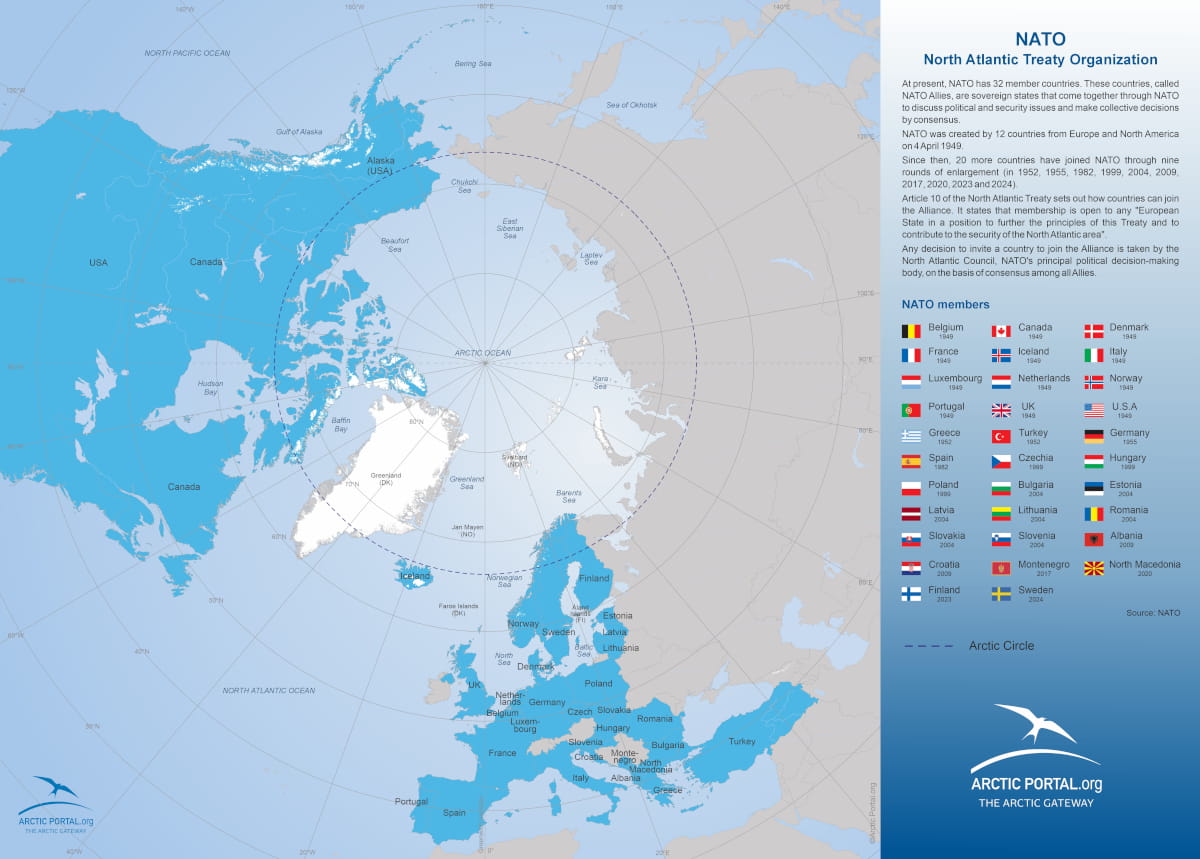
Map: Arctic Portal
The three governments are expected to sign the agreement during the United Nations General Assembly in New York. According to the Danish Prime Minister’s Office, the arrangement is intended to strengthen security in the Arctic and North Atlantic while recognising the sovereignty and territorial integrity of the Kingdom of Denmark and the Greenlandic people’s right to self-determination. Once signed, it will be subject to the necessary national parliamentary procedures before entering into force.
As of 21 September, the full text has not been published and important details concerning its implementation remain unclear. This includes the extent of future US military access, infrastructure development and the rules governing sensitive foreign investments.
Greenland and Arctic security
Greenland has long played an important role in Arctic and North Atlantic security. The Kingdom of Denmark, including Greenland, is part of NATO. Five of NATO’s founding members — Canada, Denmark, Iceland, Norway and the United States — are Arctic states, while today seven of the eight Arctic states are NATO members.
NATO has increased its focus on the Arctic and High North in recent years. In February 2026, the Alliance launched Arctic Sentry, a multi-domain military activity led by Joint Force Command Norfolk that brings together NATO and Allied activities across the region. NATO has linked this increased attention to Russia’s military activity in the Arctic and China’s growing interest in the region.
The planned Greenland–Denmark–US agreement therefore forms part of a broader effort to strengthen Arctic security. Earlier in 2026, European leaders stressed that security in the Arctic should be addressed collectively with NATO Allies, including the United States, while respecting sovereignty, territorial integrity and international law. In a joint statement issued on 6 January, they also stated that decisions concerning Greenland remain matters for Greenland and Denmark.
A new agreement with different interpretations
Greenlandic Prime Minister Jens-Frederik Nielsen welcomed the planned agreement, saying that it would strengthen the security of Greenland, the Kingdom of Denmark, the United States and the wider Western alliance. Danish Prime Minister Mette Frederiksen similarly said that the agreement would strengthen common security in the Arctic and North Atlantic while recognising the sovereignty and territorial integrity of the Kingdom and the Greenlandic people’s right to self-determination.
US President Donald Trump, however, has described the agreement in broader terms. He has said that it would give the United States “permanent control over security” in Greenland and allow Washington to take the measures it considers necessary to protect the territory. He has also said that US adversaries would not be permitted to establish a military presence or make sensitive investments in Greenland without US approval.
The official Danish announcement does not use the language of US control. Instead, it emphasises strengthened security cooperation, Greenlandic interests, the sovereignty and territorial integrity of the Kingdom of Denmark and Greenland’s right to self-determination.
Media reporting based on an unnamed US State Department official suggests that the agreement could prevent non-NATO countries from establishing military bases in Greenland and restrict investments considered a security risk. The same reporting indicates that the United States could receive expanded military access and infrastructure rights. Because the final agreement has not yet been released, the precise legal scope of these provisions and how they will operate in practice remain unclear.
A long-standing US presence in Greenland
The United States already has a long-established military presence in Greenland. Security cooperation is based in part on the 1951 Defence Agreement between Denmark and the United States, which was later amended and supplemented, including through an agreement signed with Greenland’s Home Rule Government in 2004.
Today, the main US military installation is Pituffik Space Base in north-western Greenland. The base supports missile warning, missile defence, space surveillance and satellite operations and occupies a strategically important position in the High Arctic.
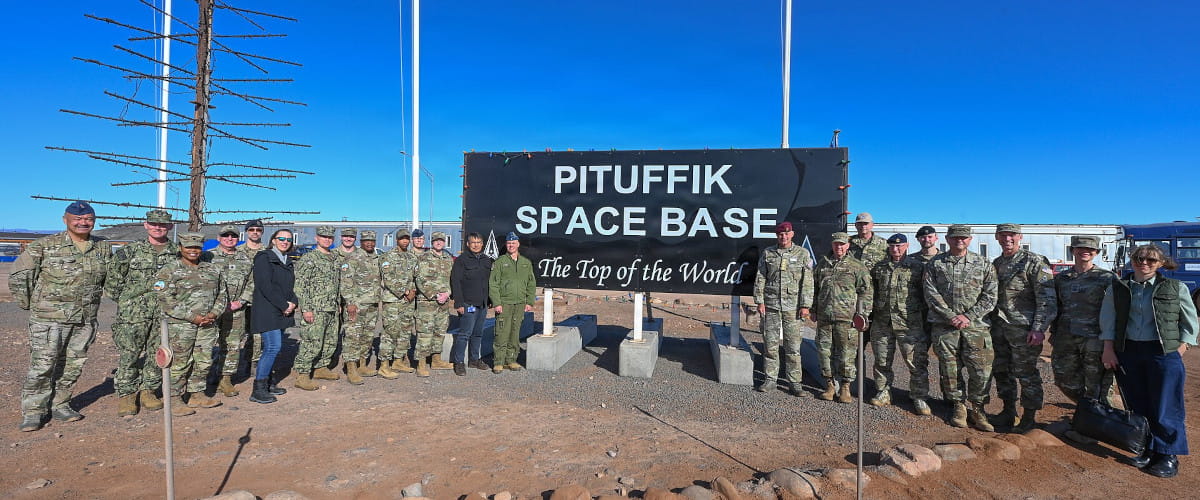
Representatives from the United States, Canada, the Kingdom of Denmark and Greenland at Pituffik Space Base during its 75th anniversary celebrations, 12 August 2026. Photo: Staff Sgt. Jaime Sanchez / U.S. Space Force
The forthcoming agreement therefore builds on an existing security relationship rather than creating a US presence in Greenland for the first time. What remains to be clarified is how the new arrangement will modify or expand that framework and how responsibilities will be divided between Greenland, Denmark and the United States.
Greenland’s growing geopolitical role
The negotiations also reflect Greenland’s increasing importance in Arctic affairs. Its geographical position between North America and Europe gives the island strategic significance for North Atlantic defence, missile warning and Arctic monitoring.
Greenland also has considerable mineral potential. Assessments by the Geological Survey of Denmark and Greenland have identified significant potential for critical raw materials, including rare earth elements, graphite, lithium and several other minerals important for modern technologies and the energy transition.
At the same time, Greenland is playing an increasingly direct role in international discussions concerning its territory and future. Under the 2009 Self-Government Act, the people of Greenland are recognised as a people with the right to self-determination under international law.
This broader international engagement was also visible on 7 September 2026, when Greenland, Denmark and the European Union signed an updated Joint Declaration in Nuuk. The declaration expands cooperation in areas including infrastructure, critical raw materials, energy, connectivity, research and innovation, civil protection, resilience, cybersecurity and the protection of critical infrastructure. It also reaffirms cooperation based on shared interests, democratic values and respect for international law.
The new Greenland–Denmark–US security agreement is expected to add another layer to this evolving Arctic security framework. Its full implications, however, will only become clearer once the complete text is published and the required parliamentary procedures begin.
Sources: BBC, NATO, STM.DK
The tags below provide an opportunity to view previously posted related news within the selected category