
News
Critical raw materials: EU selects 46 new Strategic Projects to strengthen European supply chains
Spanning extraction, processing and recycling across 16 Member States, the projects aim to strengthen supplies of materials for batteries, permanent magnets, defence and aerospace.
Strengthening capacity across the raw materials value chain
On 9th October 2026, the European Commission approved a second list of 46 Strategic Projects within the European Union under the Critical Raw Materials Act (CRMA). The selection brings the total number of recognised projects to 106, including those approved both within and outside the EU in 2025, as part of efforts to diversify supply sources and strengthen European capacity across the raw materials value chain.
The new projects are located in Belgium, Bulgaria, Estonia, Finland, France, Germany, Greece, Italy, Lithuania, the Netherlands, Poland, Portugal, Romania, Slovakia, Spain and Sweden, and cover 15 of the 17 strategic raw materials identified under the CRMA. They are expected to contribute to the EU’s 2030 benchmarks, which call for domestic extraction capacity equivalent to at least 10% of annual EU consumption of strategic raw materials, processing capacity equivalent to at least 40%, and recycling capacity equivalent to at least 25%.
To support these ambitions, the selection spans several stages of material production and recovery. Eight projects focus on extraction, eleven on processing and nineteen on recycling, while a further eight combine activities: three integrate extraction and processing, and five bring together processing and recycling. Material recovery therefore plays a substantial role alongside the development of primary resources and the industrial capacity needed to process them.
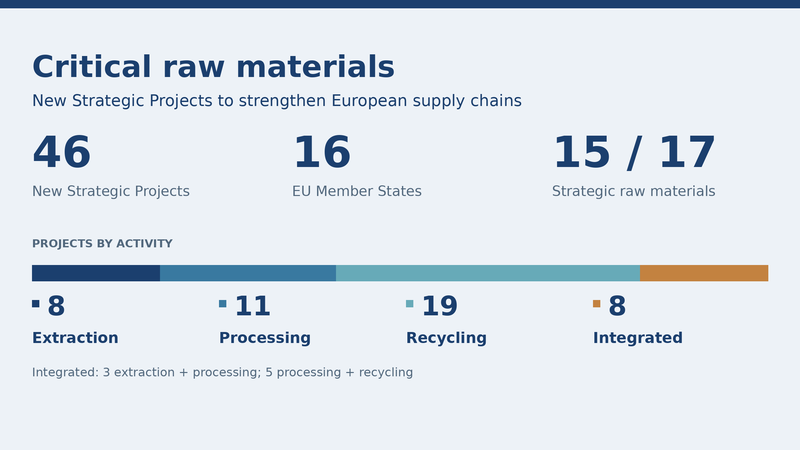
Infographic based on European Commission data
A significant share of the projects supports the European battery value chain, with seven covering lithium, twelve nickel, ten cobalt, five manganese and four graphite. Other initiatives address materials used in defence and aerospace, including two projects covering magnesium and three tungsten, while four rare earth projects support the permanent magnet value chain. These figures overlap, as individual projects may contribute to the supply of more than one material.
The selected initiatives illustrate how these priorities translate into industrial activities. In Finland, Umicore’s CoNiKo project focuses on cobalt and nickel refining, while Sokli is an extraction project intended to contribute to the supply of rare earth elements for magnets. Also in Finland, Suhanko covers copper, nickel and platinum group metals, while Sweden’s Viscaria project focuses on copper extraction.
Recycling initiatives extend across a similarly broad range of materials and end-of-life products. In Italy, 9-Tech’s 9PV-up project focuses on recovering raw materials from end-of-life photovoltaic panels, contributing to supplies of aluminium, copper and silicon metal. Germany’s HyProMag project addresses the recycling of rare earth elements for magnets, while GaRefine in Slovakia focuses on gallium. Together, these projects illustrate the range of recovery activities included in the European selection.
For researchers and raw materials specialists, these initiatives offer potential case studies for examining how extraction, processing and recycling develop across different materials and industrial settings. Assessing their technical and environmental performance will require project-specific evidence as they advance towards implementation.
From strategic recognition to operational capacity
Recognition as a Strategic Project follows an assessment of its contribution to European security of supply, technical feasibility, sustainable implementation and cross-border benefits. The Commission drew on external experts with technical, financial, environmental, social and governance expertise, as well as knowledge of the United Nations Framework Classification for Resources (UNFC).
According to the Commission’s estimates, the 46 new projects, together with the 47 selected within the EU in March 2025 and the 13 selected in third countries in June that year, could fully meet the extraction benchmarks for lithium, nickel, rare earth elements, magnesium and tungsten. Their potential contribution could also fully meet the processing benchmarks for lithium and rare earth elements, while covering 89% of the cobalt processing benchmark, 57% of the tungsten benchmark and 51% of the magnesium benchmark. For recycling, the projects could fully meet the benchmarks for lithium, cobalt and rare earth elements.
These projections refer to contributions towards the CRMA benchmarks, rather than to meeting total European demand or to production capacity already in operation. Their practical impact will therefore depend on progress through permitting, construction and commissioning.
Progress among the projects selected in 2025 provides an indication of how this process is developing: twenty-five have completed their environmental impact assessments, and seventeen have obtained construction permits. Financial support has also advanced, with the Commission reporting that Team Europe has mobilised more than €2 billion since the launch of the RESourceEU communication in December 2025, through the Innovation Fund, State aid and the European Investment Bank.
Alongside this support, efforts are underway to connect suppliers with prospective buyers. The Raw Materials Mechanism, established to aggregate demand and supply and identify potential offtakers, has generated more than thirty matches across ten materials, supporting the commercial relationships needed to bring materials to market.
The projects’ contribution to European objectives will ultimately depend on their implementation and the planned capacity becoming operational. Alongside new extraction activities, the development of processing and recycling will be central to strengthening supply chains, linking access to raw materials with the capacity to process and recover them within the European Union.
Source: European Commission
The tags below provide an opportunity to view previously posted related news within the selected category