
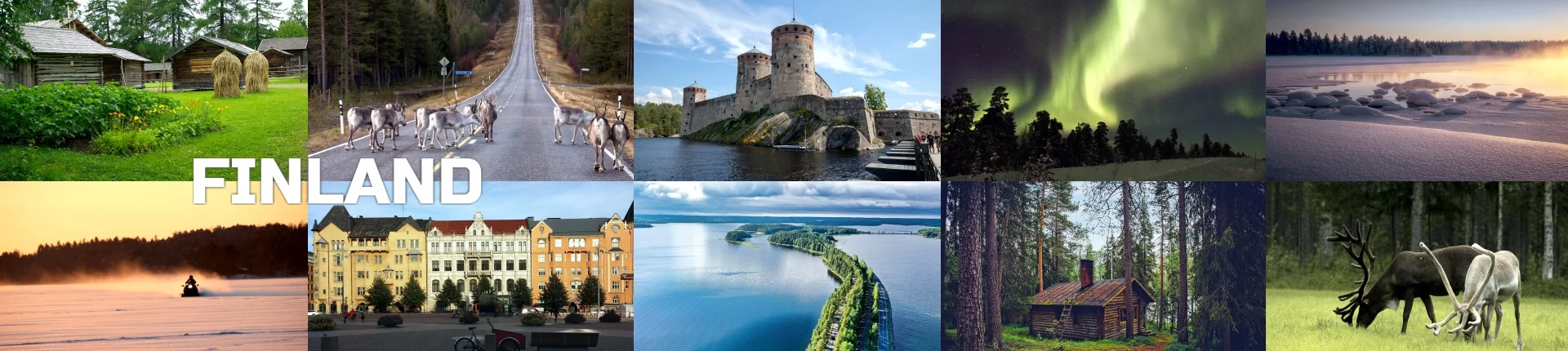
Finland


Capital
Helsinki

Population
5,630,316 (2026)

Currency
Euro (EUR)

Government
Parliamentary Republic
Highest Mountain
Halti
1,324 m

Longest River
Kemijoki
550 km

Arctic Circle Crosses
Yes
Northern Finland

Coastline
1,110 km
Including Islands

Timezone
CET (UTC+2)
CEST (UTC+3) summer
Finland is one of the five Nordic countries in the Arctic region and a key player in shaping Arctic governance and environmental policy. Finland plays a central role in Arctic cooperation, with a strong focus on sustainable development, climate change mitigation, and emerging Arctic marine technologies.
Geography and History
When talking about the Finnish Arctic, the area most referred to is Lapland, as the Arctic Circle crosses the province at approximately the same latitude as its capital, Rovaniemi. This puts one third of Finland’s territory above the Arctic Circle. As of 2014, 181,815 people lived in Lapland. The biggest industries in Northern Finland are forestry, mining, tourism, renewable and bio-energy, technology, and metal industries. Due to these industries, the infrastructure is well-maintained and connected to the rest of the country. Northern Finland is a very popular winter destination, especially its Arctic capital Rovaniemi and the Santa Claus village.
In the sixteenth century, Finland was part of Sweden. Swedish king Gustav Vasa declared that all wilderness areas that had not been previously entered into the registers of ownership belonged to the Crown. This included the northern part of Finland, which would go on to be known as Lapland. The King also encouraged citizens without land or house to move to the Crown lands in the north as settlers. He, however, also added the proviso that the new settlements should not be allowed on the hunting rights of the Sámi and issued strict regulations governing trade and fishing in the north. His son Charles IX spearheaded the beginning of Arctic policy.
By the 17th century, Sweden became a major power in Europe and sought to establish its northern border at the Arctic Ocean. In 1673, a decree was published concerning the colonization of the northern parts of the realm, with a border that was supposed to separate the Sámi and the Finns. In 1751, revisions were made to the border between Denmark-Norway and Sweden, leading Sweden to lose significant overland connections to the Arctic Ocean, but Sámi and other inhabitants living in Lapland could still cross the new border. From the 18th century onwards, many expeditions ventured into the Finnish Arctic, hailing from different parts of the world. An expedition arranged by French astronomer Pierre Louis Moreau de Maupertuis in 1736-37 measured the degrees of latitude in the Tornio Valley to determine whether Earth was flattened at the poles and gained great international attention. Swedish authorities also made a great deal of effort from the 1750s onwards to develop living conditions in Lapland, and academic and exploratory activities contributed to it significantly.
The war of 1808-1809 between Sweden and Russia led to the creation of the Grand Duchy of Finland as an autonomous buffer zone between the two major powers. The border dividing Finland and Sweden ran through the Tornio Valley. “Finish Lapland” and its inhabitants became an object of study for Finnish academics and explorers, most notably the mineralogist and polar explorer Adolf Erik Nordenskiöld. He would go on to become famous for becoming the first one to sail through the North-East Passage in 1878-89. The 19th century was also a time when the exploitation of the forest resources of Northern Finland began to support the growing sawmill, pulp and paper industries. Due to the amount of infrastructure needed, colonization of the area increased dramatically.
Nationalism of the 19th century led to tighter border controls and restrictions, including the Arctic. An issue arose with Russia over Finnish inhabitants having access to the Arctic Ocean, and a corridor leading to the Petsamo fjord was eventually established in 1920, after an almost 70-year campaign by the Finns. The 1930s were marked by industrialization and internationalization of the Finnish Arctic, with huge deposits of nickel ore found in the Petsamo area. Finland’s first nature conservation areas in the northern parts of the country were put into law in 1938. Finland lost Petsamo to the Soviet Union again after the Continuation War of 1941-1944. During their retreat and the end of the Second World War in 1945, the German forces set fire to all main centers of population in Lapland, leaving the region destroyed.
The post-war period was characterized by the rebuilding and re-profiling of the north, focusing on development of technology in the Arctic as well as exploitation of water power and ore resources. Five universities were established in the north between 1958 and 1979. Lapland was reframed as a region with a bright, multicultural future and potential for tourism.
Indigenous People
Finland is home to a small but significant indigenous Sámi population, numbering around 10,000. The Sámi people inhabit the northern regions of Finland, known as Sápmi, which spans across parts of Finland, Norway, Sweden, and Russia. The process of ethnic mobilization for the Sámi came at the end of the nineteenth century, when their environment and life changed more drastically than before due to industrialization and nationalism. When the people of Lapland were living in exile at the end of the Second World War, the Sámi formed a joint ethnic organization, the Sámi Litto, in 1945. Efforts eventually led to the founding of the Finnish Sámi Parliament. Through it, the Sámi exercise their cultural and linguistic autonomy. The parliament continues to advocate for Sámi rights, including land and resource management, as well as the protection and promotion of Sámi languages and traditions.
Climate Change and Sustainability
Finnish Lapland has been upheld as an example of how ecosystem services can help prevent ecological problems caused by human action, as well as a way to resolve land-use questions in an economically and environmentally sustainable way. The most forested country in Europe, Finland has attempted to position itself as a leader in sustainable development in the Arctic region. Moreover, Finland is often rated among the world’s top countries in terms of environmental protection standards. In spite of these impressive achievements, Finland’s ecological footprint is still quite high when compared to its Nordic neighbors.
Arctic Governance and Sovereignty
Finland has been a member of the EU since 1995 and of NATO since 2023. Finland’s political initiative as an EU Member was the Northern Dimension initiative, launched in 1997. It urged increasing cooperation between the EU and outside organizations, as well as improving the coordination between different programmes within the EU that were concerned with the Arctic. As an EU Member, Finnish Arctic policy follows the EU Arctic Policy.
Finland is a member of the Arctic Council and held the chairmanship in 2000-2002 and 2017-2019. Its next chairmanship will be in 2033-35. Within the Arctic Council, Finland's priorities are sustainable development in the Arctic, capacity building to increase the ability at all levels of society to access and manage different capital resources to develop sustainably and promoting decision-making based on science informed by traditional knowledge.
Rovaniemi
The northern Finnish city of Rovaniemi is situated directly on the Arctic Circle and serves as the main urban hub in Finland’s Arctic region. With a population of around 63,000 people, Rovaniemi covers an expansive area of 8,017.20 km². The city has become a center for Arctic research, with institutions like the University of Lapland and the Arctic Centre, which focus on climate research, Arctic governance, and sustainable development. Rovaniemi continues to be an important crossroads for Arctic stakeholders and a symbol of Finland's commitment to the region’s future.
Read Finland's Arctic Foreign and Security Policy
Sources: The Arctic Institute; Small State Influence Within the EU: The Case of Finland's ‘Northern Dimension Initiative’ - https://doi.org/10.1111/1468-5965.00260 ; Footprints in the Snow: The Long History of Arctic Finland