
News
Sea Ice in the Arctic reaches Annual Minimum Extent for 2026
Arctic sea ice reached its annual minimum for 2026 in mid-September according to NASA and the National Snow and Ice Data Center (NSIDC) at the University of Colorado Boulder. It covered about 4.6 million square kilometers, tying with 2008, 2010 and 2025 for the tenth lowest spot since satellite records started nearly 48 years ago.
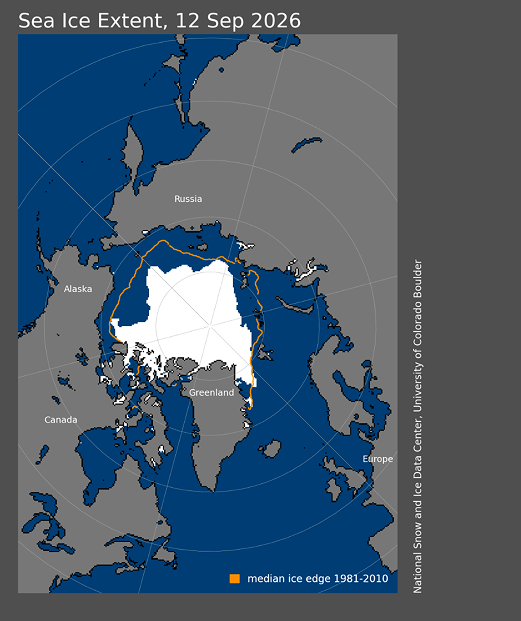
Credit: National Snow and Ice Data Center (NSIDC), University of Colorado Boulder
Arctic sea ice most likely reached its annual minimum extent for 2026 on September 12th, according to NASA and the National Snow and Ice Data Center (NSIDC) at the University of Colorado Boulder. It covered about 4.6 million square kilometers, tying with 2008, 2010 and 2025 for the tenth lowest spot.
According to NSIDC, significant patches of low ice concentration still remain, and a late season could impact sea ice and push the extent even lower. Full data and analysis will be available in early October. Arctic sea ice grows during the autumn and winter and retreats during the spring and summer, with weather conditions able to cause significant differences from year to year. For example, according to Linnete Doisvert, a sea ice scientist at NASA, an increase in cloud cover has prevented further accelerating the melting of sea ice because it protects the Arctic from solar radiation.
The last 20 years are the 20 lowest ice extents since satellite records started nearly 48 years ago. However, at the same time, there seems to be no significant decline in September minimum extents in the past 20 years. The cause of this is a source of debate among Arctic scientists.
On the other side of the world, the Antarctic sea ice extent likely reached its annual maximum on September 14th at 17.59 million square kilometers. Though fluctuations are typical, if the ice does not grow more, it will be the third lowest Antarctic sea ice maximum on record.
Look at our maps of sea ice extent in the previous years
Source: NASA, NSIDC
The tags below provide an opportunity to view previously posted related news within the selected category