
Robert E. Peary (1856-1920)
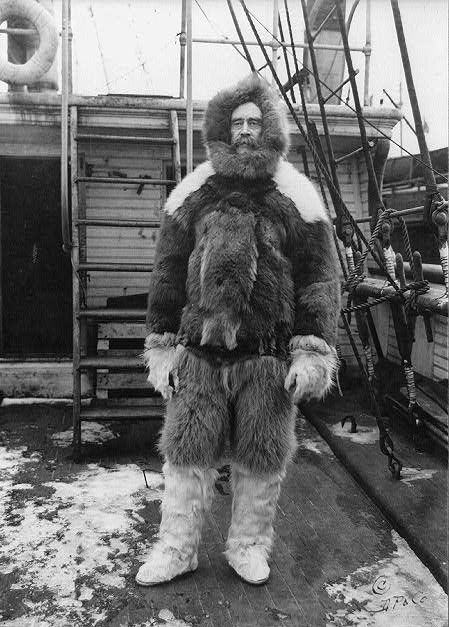
Robert Edwin Peary (6 May 1856 – 20 February 1920) was an American Arctic explorer best known for his claim to have reached the North Pole on 6 April 1909. He undertook multiple expeditions to Greenland and the High Arctic and became one of the most prominent figures of the so-called “Heroic Age” of polar exploration.
Early Life
Peary was born in Cresson, Pennsylvania, and grew up in southern Maine. He graduated as a civil engineer and later joined the U.S. Navy’s Civil Engineer Corps. After moving to Washington, D.C., he met Matthew A. Henson, who would become his longtime expedition partner and a key member of his Arctic journeys.
Peary first traveled to Greenland in the 1880s and became deeply committed to Arctic exploration. Over the next two decades, he made several attempts to reach the North Pole, refining his logistical strategies and learning Arctic travel techniques, including dog sledding and survival skills from Inuit communities.
In 1905, his specially designed expedition ship, Roosevelt, was built to withstand heavy Arctic ice. Peary used the vessel for multiple northern expeditions.
The 1908–1909 North Pole Expedition
In 1908, Peary launched what would become his final attempt to reach the North Pole. The expedition sailed aboard the Roosevelt to Ellesmere Island in northern Canada and established a base camp at Cape Columbia.
In March 1909, Peary and a support team set out northward by dog sled. The party included Matthew Henson and several other crew members, among them Captain Robert Bartlett, Donald B. MacMillan, George Borup, Ross G. Marvin, and Dr. John W. Goodsell. Henson played a crucial role in building sledges and managing travel logistics.
As the expedition advanced across the drifting sea ice, support teams gradually turned back according to Peary’s “relay” system. In the final stage, Peary continued with Matthew Henson and four Inuit companions: Ootah, Egigingwah, Seegloo, and Ooqueah.
Peary claimed they reached the North Pole on 6 April 1909.
Controversy and Recognition
Peary’s claim was immediately disputed, particularly by American explorer Frederick Cook, who claimed to have reached the Pole the previous year. Questions have also been raised about Peary’s navigational records and calculations. Some later analyses suggest the party may have been short of the exact geographic pole by several tens of kilometers.
Despite the controversy, the U.S. Congress formally recognized Peary’s achievement in 1911. In 1990, the National Geographic Society re-examined his records and concluded that, given the navigational tools available at the time, Peary was likely very close to the North Pole.
Today, historians continue to debate the exact accuracy of the claim, but Peary remains a central figure in the history of Arctic exploration.
Matthew Henson and Inuit Contributions
Modern scholarship increasingly recognizes the vital role of Matthew Henson and the Inuit team members who made the expedition possible. Henson was an experienced Arctic traveler and navigator, and some accounts suggest he may have reached the Pole slightly ahead of Peary.
The knowledge, skills, and logistical support of Inuit communities were essential to the success of Peary’s Arctic expeditions.
Later Life and Death
After returning from his final expedition, Peary declared:
"My life work is accomplished... I have got the North Pole out of my system. After 23 years of effort, hard work, disappointments, hardships, privations, more or less suffering, and some risks, I have won the last great geographical prize."
He was promoted to Rear Admiral in the U.S. Navy and spent his remaining years lecturing and writing about his experiences.
Robert E. Peary died on 20 February 1920 at the age of 63.
Sources:The Arctic by Richard SalePolar Reaches by RIchard Sale